
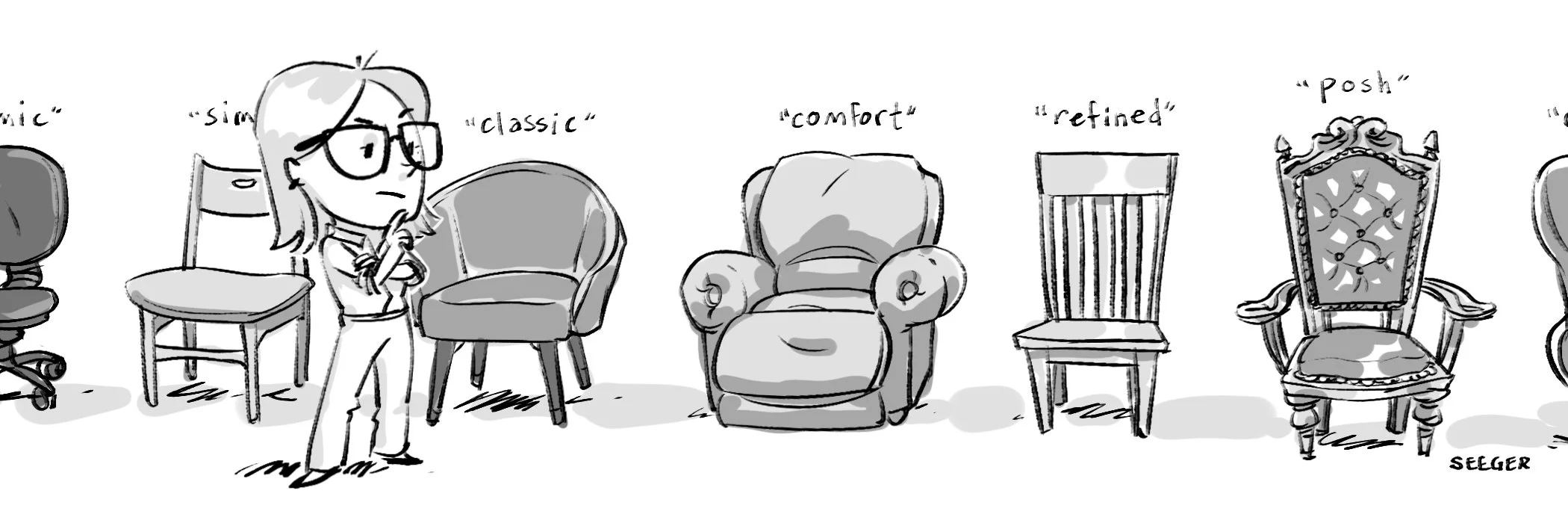
This week’s blog comes from one of my lifelong interests: storytelling. As an artist, my work has mostly been in narrative media, like video games, film, and publishing, where storytelling is an obvious focus. Great stories have the power to change our lives, which is what drew me to this kind of work. However, I have come to think that storytelling is even more fundamental to the human experience than that. Storytelling is the way that we humans process the world around us, contextualizing and filtering the terabytes of data we are exposed to into ideas that we can understand and act on. Stories are how we make meaning. For us, everything is storytelling.
This idea influences the way I view a lot of aspects of life, but lately I have been thinking about it in several particular contexts: first, the way that the design of objects tells a story about the society that created them as well as the individuals that use them. Second, the ways that storytelling shows up in the world of business. And finally, how we can use storytelling to make more conscious decisions about the direction of our lives.
Story in Design
We are all familiar with storytelling in media- a painting depicts a moment of drama, a photo captures a piece of history. But I think we can similarly read a story onto anything in the world, and that doing so is an interesting way to understand the values and capabilities of a society. The design of the pyramids tells a story about the ancient Egyptians’ belief in the divinity of their rulers and their desire and skill to create an epic monument supporting that belief. In the same way, the design of a plastic hair clip or a water bottle or a cell phone reflect the values and abilities of our modern society- our ideas about beauty, individuality, convenience, etc. From a historical perspective, this kind of analysis reveals cultural differences and changes over time- everything humans make contributes to the story about the evolution of society.
At an individual level, design is a significant part of crafting the stories we have about ourselves. This story-of-self is more apparent than ever in the age of social media, but even outside of our phones, we are each constantly writing an internal story. What kind of person am I? How do I want others to perceive me? We might not think about these kinds of questions consciously, but they still shape our decisions about what we do and the objects we use. Even if someone is disinterested in design or style, that is a story which will be reflected in their choices- “I don’t care about fashion” is a story that might lead them to wear hand-me-downs or choose clothing based on comfort. Humans are uniquely reliant on tools and our built environment, and as long as we have options about the objects we use, our choices will reflect the story we tell about ourselves in the context of our society. “I am a business woman,” so I wear a certain suit. “I am a dad,” so I choose a particular car. In the modern world, where more people than ever have access to hundreds of versions of any object, design is even more relevant to self-concept and self-expression.
This has a plethora of implications. For example, costume and set design can be used in narrative media to tell a deep and compelling story about a character without using any words. This is one of my favorite forms of storytelling- I love getting into a character’s head and thinking about what kind of sofa they would own or the makeup they would use. And in the real world, businesses use a similar process to decide how to design and market their products.
Story in Business
Perhaps no one is more aware of the power of storytelling than marketers. In order to stand out in a crowded field of options, marketers have learned to tune in to the stories of meaning we tell ourselves. If our choice of lamp is based on our story of self-image, marketers want to deliver a product that fits perfectly into that story. Of course, it’s hard to meet every single individual’s needs, because each of us has a unique story- but there are plenty of commonalities across groups of people with shared interests or experiences. We think of ourselves as stylish, or eco-conscious, or edgy- and businesses are more than happy to provide us with objects that align with those values. In some cases, they can even influence the stories we tell ourselves- razor companies and mouthwash brands managed to convince us to care about parts of our self-image we hadn’t previously thought about, and smart phones have transformed the way we communicate our stories to the world. In this way, there is a constant interplay between individuals’ stories, the broader societal/cultural story, and marketing; we make choices that we think of as our own, but those choices are influenced by society and product offerings, which in turn are influenced by consumers’ stories. I think Miranda Priestly said it best in The Devil Wears Prada: “…you think that you’ve made a choice that exempts you from the fashion industry when, in fact, you’re wearing a sweater that was selected for you by the people in this room from a pile of stuff.”
There is, of course, a big ethical question to all of this: should businesses appeal to our core beliefs about ourselves in order to sell us stuff? It’s something that gives many people the ick- faceless, soulless corporations hijack our most human stories for the sake of profit. I’ve had some interesting conversations about this with my peers, and would like to write a dedicated blog about it later- but for now, suffice to say that storytelling is an essential part of modern business, both to understand buyers’ values and to sell the right products to the right customers.
Story in Life
To tie all of this together, I think that being aware of the storytelling happening around us- and inside us- can help us live more intentionally. Our lives are built by the choices we make, and those choices are based on stories we tell ourselves about who we are and who we can be. We often carry negative assumptions that limit what we imagine for ourselves: “I’m too awkward”, “I’m not talented enough”, or “I know I’ll fail anyway”. These kinds of stories can be very powerful, especially if they have never been consciously acknowledged. Challenging the stories that comprise our self-image can empower us to direct our lives in ways that are truly meaningful. For me, letting go of my limited idea of ‘artist’ helped me expand my perception of what I am capable of, and allowed me to explore new career paths that I would never have previously considered. It also, funnily enough, helped me reconnect to my personal passion for art, which I had lost sight of while performing the role of ‘professional artist’. It has been exciting to learn that I can be an artist and more, and to think about where my life path can lead if I open my mind to new possibilities.
I hope this inspires you to think about the stories in your world: how do your favorite things fit into your story-of-self? What stories do you tell yourself about other people based on what they own? Societally, what stories are told by the design of our street signs or public parks? Do these stories reflect the values we claim to have? And most importantly: which stories shape the choices you make?
